Vibro Piling vs Silent Piling: Which Method Is Right for Your Project?
Every deep excavation starts with a decision: how will the ground be held back? For many projects in Singapore, the answer is an earth retaining and stabilising structure (ERSS) built from sheet piles, soldier piles or steel plates. The next question is how to install them. The two most common methods are vibro piling and silent piling, and choosing between them can affect your cost, programme and relationship with your neighbours.
What is vibro piling?
Vibro piling uses a vibratory hammer clamped to the top of a pile. The hammer shakes the pile at high frequency, which reduces the soil’s resistance and lets the pile sink into the ground under its own weight and the weight of the machine. The same equipment can be run in reverse to extract the pile when the temporary works are finished.
Vibratory hammers can be mounted on an excavator or on a crane:
- Excavator-mounted vibro is quick to mobilise and works well on confined or uneven sites, which makes it a common choice for shallow to medium excavations, trenches and utility works.
- Crane-mounted vibro offers greater reach and driving capacity, so it suits longer piles, deeper excavations and larger sites.
Advantages
- Fast installation and extraction
- Flexible and economical for many ground conditions
- Wide range of pile types (sheet piles, soldier piles, steel plates)
Things to consider
- Produces noise and ground vibration that must be managed
- May not be suitable close to sensitive structures
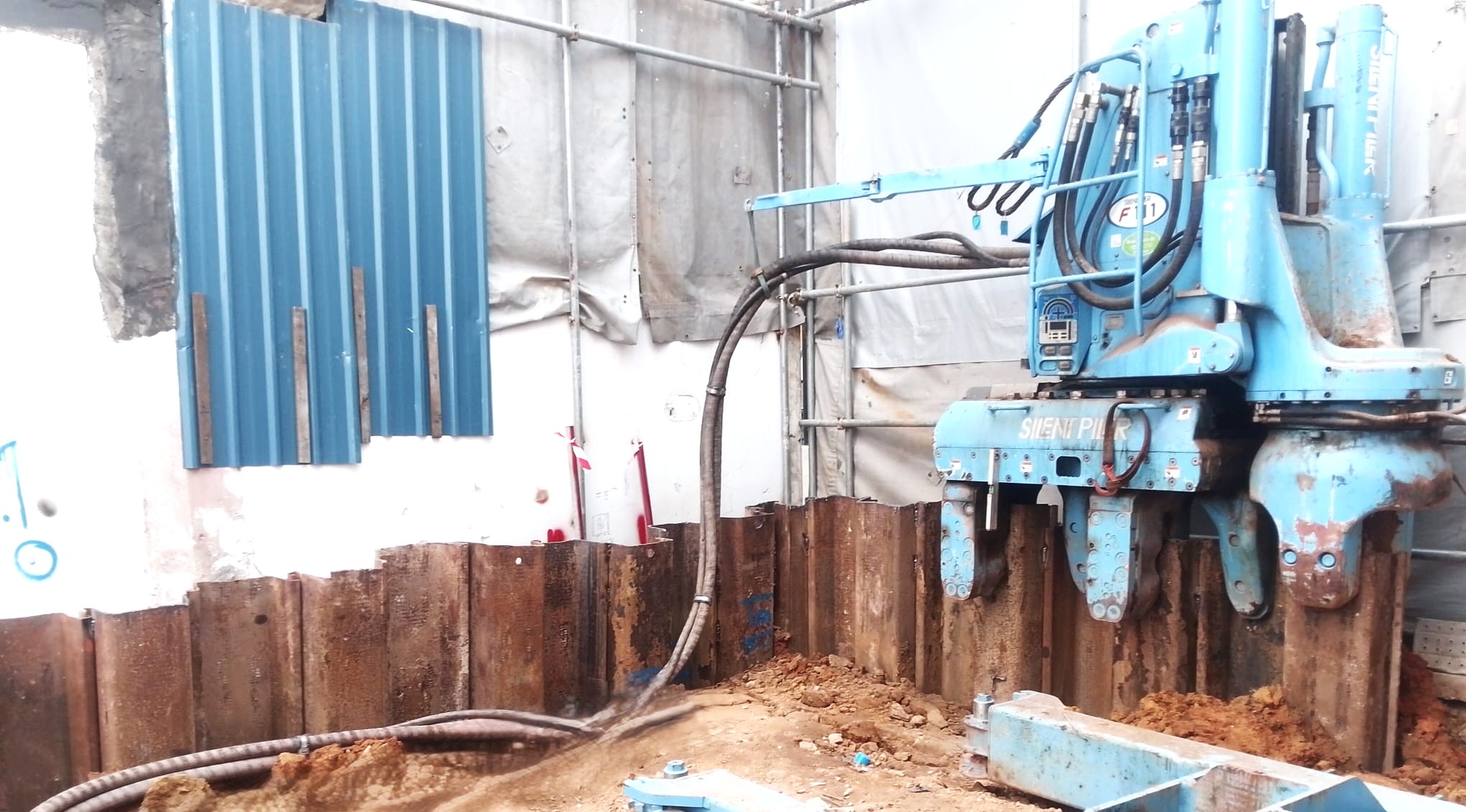
What is silent piling?
A silent piler works differently. Instead of vibrating or hammering, it uses hydraulic force to press piles into the ground, using the resistance of the piles already installed as a reaction. The result is installation with very low noise and vibration.
Advantages
- Minimal noise and vibration
- Suitable next to existing buildings, utilities, rail structures and residential areas
- Controlled, precise installation
- Helps you meet environmental and neighbour requirements
Things to consider
- Generally slower than vibro on some projects
- Very hard ground or obstructions may need pre-augering
- Set-up and site access need to be planned in advance
Which one should you choose?
There is no single best method. The right choice depends on your site. Here are the main questions to ask:
- How close are the nearest structures and services? Tight proximity to MRT structures, old buildings or live utilities favours silent piling.
- What are your noise and vibration limits? Strict limits point towards silent piling, while relaxed limits make vibro attractive.
- How deep is the excavation, and how long are the piles? Deeper work often calls for crane-mounted equipment.
- What is the ground like? Hard layers or obstructions may need augering to help piles reach the required depth.
- What are your programme and budget? Vibro is often faster and more economical when conditions allow.
In practice, many projects use a combination, for example silent piling along a sensitive boundary and vibro piling elsewhere. Working with a contractor that offers both lets you choose the best method for each part of the site instead of forcing one solution everywhere.
Don’t forget the supporting works
Piles are only part of an ERSS. Strutting and walers keep the wall stable as excavation deepens, decking provides safe access over open excavations, and utility support protects existing services. Welding quality matters too, and non-destructive testing such as MPI and UT checks that critical connections are sound. Planning all of this together, with approved designs and sequences, is what keeps an excavation safe.
Work with a contractor that offers every option
At Uni-Zone Structural Pte Ltd, we provide excavator-mounted and crane-mounted vibro piling, silent piling, soldier pile and steel plate works, strutting, decking, augering, utility support, welding, MPI and UT testing, and site/in-house fabrication, so you can deal with one team from start to finish.
Planning an excavation and not sure which method suits your site? Contact us with your location, depth and constraints, and we will help you find a practical, safe and cost-effective solution.