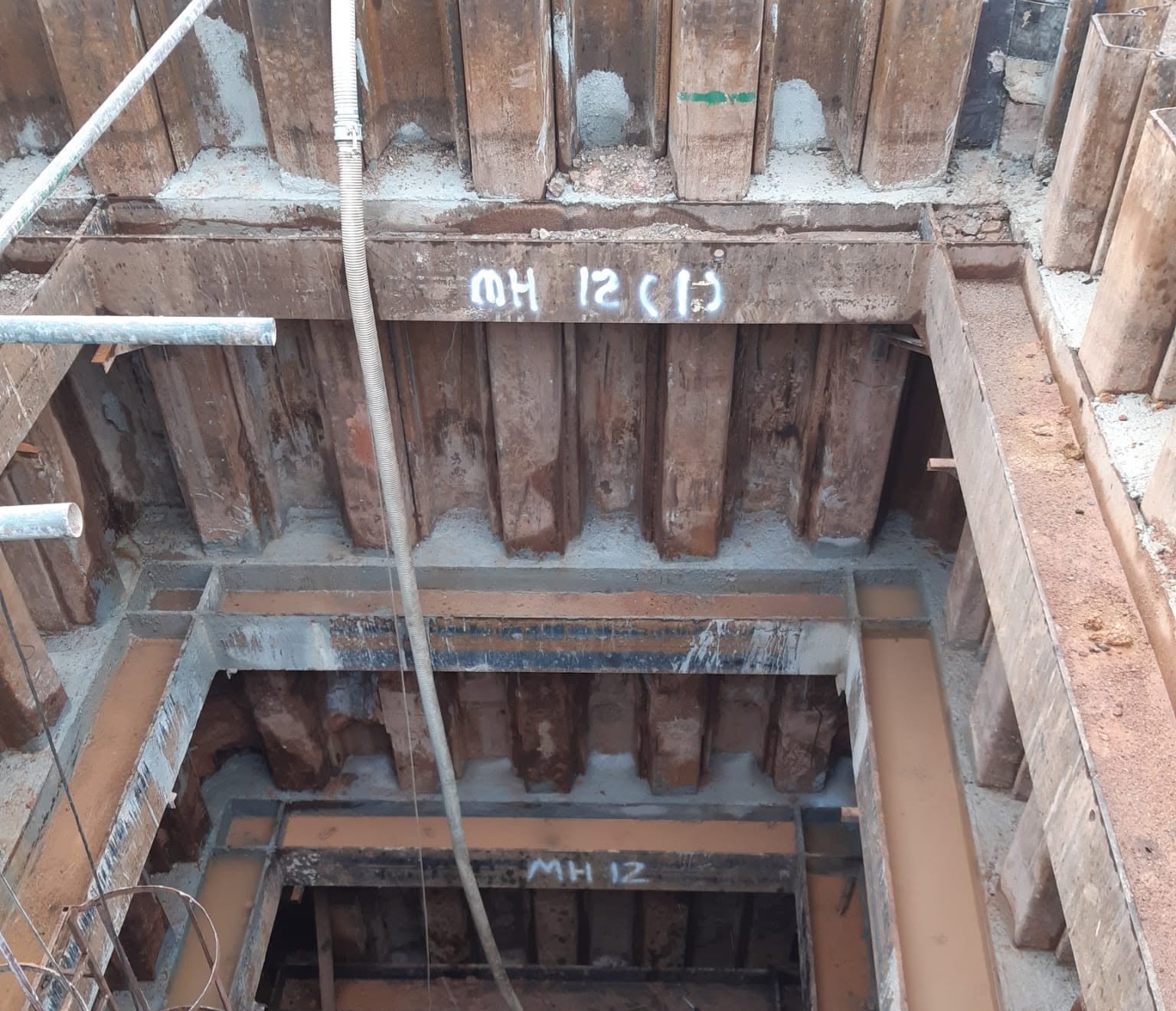
When you excavate deep, the soil and water behind the wall push inward. Sheet piles or soldier piles alone cannot always resist that load, so we brace them. That is the job of strutting.
How it works
A strut is a steel member that spans the excavation and pushes against the wall on the opposite side. Walers are horizontal beams fixed along the wall, which collect the load from the piles and pass it into the struts. Together they turn a flexible wall into a stable, braced system.
Why sequence matters
Strutting follows the design stage by stage: excavate to a level, install the strut, then continue. Excavating too far before a strut is in place can overload the wall. That is why designs specify exact levels and why we install to the approved sequence.
What good strutting looks like
- Members fabricated and welded to the approved drawings
- Tight, correct connections between struts, walers and piles, with no gaps or loose packing
- Preload applied where the design requires it
- Regular checks for movement, damaged members and accidental impact from plant
- Instrumentation and monitoring reviewed against trigger levels
Removal is a critical stage too
Struts are removed only when the permanent structure, such as a slab, can take over the load, and in the sequence the design allows. Early or out-of-sequence removal is a real risk.
Our role
We supply, install, and remove temporary strutting and walers, with in-house fabrication and welding backed by MPI and UT testing for critical connections.